Karkardooma is three stops from Laxmi Nagar on the Blue Line. It is also the one area in this catchment with an occupational character strong enough to change what people should be studying — so this page spends most of its length on that rather than on the commute.
The courts complex changes the question
The Karkardooma courts complex and the district centre around it support a dense professional population: advocates, tax practitioners, chartered accountants in small practice, and the clerical and support staff who work for all three. Enquiries from Karkardooma skew heavily towards people who already work adjacent to tax and accounting without being qualified in either.
That is a genuinely different starting point from a fresh graduate, and it changes what the right course is. Someone clerking for a tax practitioner has already absorbed a great deal of practical exposure by osmosis. What they lack is structure and a credential — and crucially, the gap is usually tax-shaped rather than accounting-shaped.
Read this before choosing DFA
If you work in or around the Karkardooma legal and tax ecosystem, the Diploma in Taxation Law is very often the better course for you than this one. It is three months rather than twelve, Rs 20,000 rather than Rs 60,000, and it covers direct and indirect taxation with the income tax and GST portals — which is the work actually being done in the offices around the courts.
We are saying that on a page selling the more expensive course because it is true, and because a student who takes the wrong twelve-month diploma does not come back. If tax is the direction, take the tax diploma. The comparison between them is set out in the GST course versus diploma in taxation guide.
When DFA is still the right choice from Karkardooma
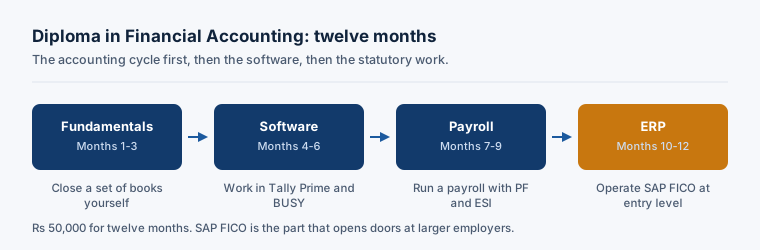
There is a real case for it, and it is this: tax practice sits on top of accounting, and a practitioner’s clerk who understands the filings but not the books has a ceiling. The Diploma in Financial Accounting covers the full accounting cycle, payroll with PF and ESI returns, and Tally Prime, BUSY, SAP FICO and MS Excel across twelve months.
If your intention is to move from supporting a practice to running accounts for clients — or to leave the legal ecosystem for a company accounts department — then the accounting foundation is the thing you are missing and the twelve months are justified. Full detail is on the course page.
Fee
The programme is priced at Rs 60,000 across the full year: tuition, all four packages, payroll and returns practice and the post-exam diploma included. Set beside the three-month tax diploma at Rs 20,000, it is three times the outlay, which is exactly why the earlier section urges you to check the subject fits before paying it.
Who in Karkardooma this suits — and who it does not
It suits someone in the court-adjacent professional ecosystem who wants to move into accounting proper, or who has hit the ceiling that comes from knowing filings without knowing books.
It does not suit you if you intend to stay in tax practice. Take the three-month tax diploma, at a third of the cost, and come back for the accounting qualification later if the work pulls you that way.
It does not suit you if you are studying LLB and want a tax credential alongside it. That is squarely the tax diploma’s case, not this one’s.
Common questions from Karkardooma
I work for a tax practitioner. Which course should I take?
Most likely the three-month Diploma in Taxation Law, not this one. Take DFA if you want to move into accounting rather than deeper into tax.
Can I do both?
Yes, and sequencing matters. Take the shorter tax diploma first if tax is your current work, then add the accounting diploma if you decide to broaden. Doing them in parallel is not advisable.
Does the accounting diploma cover GST?
It covers accounting including the entries that tax filings are built from, but the tax diploma is the one that covers the tax law and the portals properly.
I am doing LLB. Is this useful?
Less useful than the tax diploma, which is explicitly noted as suitable for LLB students. This one is aimed at accounting roles.