Anand Vihar is four stops from Laxmi Nagar on the Blue Line. It is also, unlike everywhere else in this catchment, less a neighbourhood than a gateway — and that changes the arithmetic of a twelve-month course substantially.
Most people enquiring from Anand Vihar do not live there
The ISBT and the railway terminal mean Anand Vihar is where a large number of students arrive rather than where they live. The enquiries come from Ghaziabad, from Meerut, from further into western Uttar Pradesh — people for whom Anand Vihar is the point at which their journey becomes a Delhi journey.
For that group the fee is not the whole cost, and pretending otherwise does them a disservice. A twelve-month course running six days a week is roughly 300 attendances. If your door-to-door journey is ninety minutes each way, the course costs you Rs 60,000 and about 900 hours of travelling. That is not an argument against it. It is an argument for doing the sum before enrolling rather than discovering it in month three, which is when this particular decision usually unravels.
Do the arithmetic first
Before anything else, work out three numbers honestly:
- Your real door-to-door time, including the leg to Anand Vihar, not just the Metro portion.
- Your monthly travel cost across six days a week for twelve months.
- Whether the online mode works for you. The course is offered as classroom or online. For students travelling in from outside Delhi, online is a serious option rather than a fallback, and it is worth asking about directly.
If those numbers work, the course is a good one. If they do not, a shorter course or the online mode is the better answer — and either is better than enrolling and stopping in month four.
What the course covers
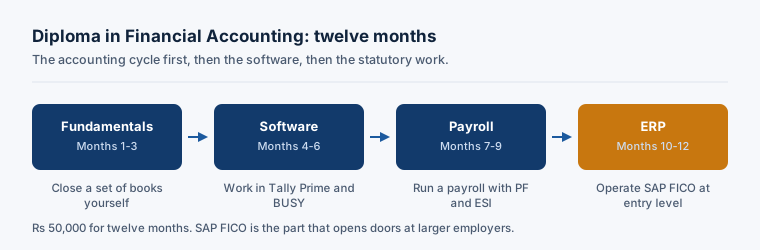
Over twelve months the syllabus works through the full cycle of accounts, payroll including PF and ESI, and four packages, Tally Prime, BUSY, SAP FICO and Excel, the last of which is recognised well beyond East Delhi. Entry follows 12th or B.Com and does not require a commerce background. The course page carries the mode options and module list.
Fee
Rs 60,000 buys the twelve months, tuition, the four packages, payroll practice, and the diploma once the online exam is cleared, but travel is not part of that figure. For this catchment specifically, add the Metro cost across the full year before treating Rs 60,000 as the whole commitment.
Who in the Anand Vihar catchment this suits — and who it does not
It suits someone commuting in who has done the arithmetic above and concluded it works, or who intends to take the course online.
It does not suit you if you are relying on enthusiasm to carry a three-hour daily round trip for a year. It will not. This is the single most common reason students from outside Delhi drop out of long courses, and it is entirely predictable in advance.
Consider instead the three-month Diploma in Taxation Law if the commitment is the obstacle rather than the subject. Three months of that commute is a materially different proposition from twelve.
Common questions from the Anand Vihar catchment
I am travelling from Ghaziabad. Is the online mode the same course?
The course is offered classroom or online. Ask directly what differs between them before choosing — for a long commute it is the most important question you can ask.
Is the diploma recognised outside Delhi?
It is an institute diploma. What travels is the practical capability behind it, particularly the ERP exposure, which employers across the NCR recognise.
Can I attend fewer days a week?
The course structure is fixed, but the mode is not. If attendance frequency is the problem, ask about online rather than about attending less.
Is there a shorter option?
Yes — the tax diploma is three months at Rs 20,000. Whether it is right depends on whether you want tax or accounting, not only on the length.