Of the twenty-one combinations of course and area on this site, this is the one where the two fit together without needing an argument. Karkardooma does tax work. This is the tax course.
The courts complex is a tax economy
The Karkardooma courts complex and the district centre around it support a dense professional population — advocates, tax practitioners, chartered accountants in small practice, and the clerks and assistants who keep all of them running. A great deal of what happens in those offices is direct and indirect tax work: assessments, notices, returns, representations.
The people who enquire from Karkardooma are frequently already inside that world without being qualified in it. They have absorbed a lot by proximity. What they lack is the structure underneath — why a provision applies, not just which form it produces — and a credential that lets them charge for it.
That is exactly what a three-month taxation diploma is for. It is not a career change. It is the formalisation of work you are already near.
What the three months cover
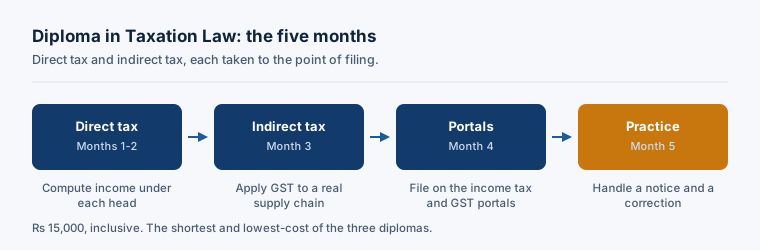
Direct tax, indirect tax, and the portals that file both, the Income Tax Portal and GST Portal alike, alongside Tally ERP and MS Excel, make up the three months. Open after 12th pass or B.Com, and named explicitly for junior accountants, financial advisors and LLB students, a mix that describes much of the courts-complex workforce.
Fee
Three months of study costs Rs 20,000, tuition, materials, the exam and the certificate all bundled into that figure. Against a practitioner’s clerk’s existing exposure to the work, it is a small outlay for the credential that lets you charge for what you already do.
Who in Karkardooma this suits — and who it does not
It suits a practitioner’s clerk or assistant who wants the structure and the credential behind work they are already touching.
It suits LLB students in or around the courts who want a commercial specialisation that pairs with the degree rather than competing with it.
It does not suit you if your actual gap is accounting rather than tax. Tax practice sits on top of books, and a person who knows filings but not ledgers has a ceiling. If that describes you, the Diploma in Financial Accounting is the longer, more expensive, and correct answer.
It does not suit you if you want a salaried corporate finance role. That is BAT‘s territory.
Common questions from Karkardooma
I am doing LLB. Does this fit alongside it?
It is one of the groups the course is explicitly aimed at. Tax is a commercial specialisation that a law degree does not supply on its own.
Will this let me practise as a tax consultant?
It gives you the working knowledge and a diploma. What a given kind of representation requires by way of registration or qualification is a separate question, and you should check it for the specific work you intend to do rather than assume.
Does it cover GST as well as income tax?
Both — direct and indirect — with portal work on each. For GST depth specifically, see also the GST return filing guide and how the GST course and this diploma differ.
Three months seems short. Is it enough?
For tax specifically, yes. It is short because it is specialised, not because it is thin — the six- and twelve-month diplomas are longer because they cover accounting as well.