Shakarpur has no Metro station of its own and does not need one for this. It sits directly against Laxmi Nagar, and for most of the area E-56 is a walk rather than a journey. It is also the densest residential catchment the institute draws from, with a large population of students sharing rooms while they study, and that population asks a very particular set of questions about a first computer course.
The real constraint here is a machine, not the class
Ask a student in a shared room in Shakarpur what is stopping them learning computers and the answer is rarely the tuition. It is that they own a phone and nothing else. A phone will do almost everything social and almost nothing clerical, and you cannot build a spreadsheet habit on one.
That makes classroom attendance worth considerably more here than the timetable suggests, because the point of coming in is as much the equipment as the teaching. Anyone in this position should ask directly, before enrolling, how much time on a machine the course actually provides and whether there is any access outside the taught session. It is a fair question and the answer should be specific.
Walking distance changes what a short course can achieve
Skills like typing, file management and formula work respond to frequency rather than intensity. Twenty short sessions beat five long ones, and living within walking distance is what makes twenty sessions possible. Students travelling in from further out lose that option entirely, and it shows in how quickly the first month sticks.
The trap worth naming is the opposite one. Being able to walk to a course is a reason to attend it reliably, not a reason to choose it over something that suits you better. Proximity should decide your attendance, not your syllabus.
Cost and commitment, for people managing their own money
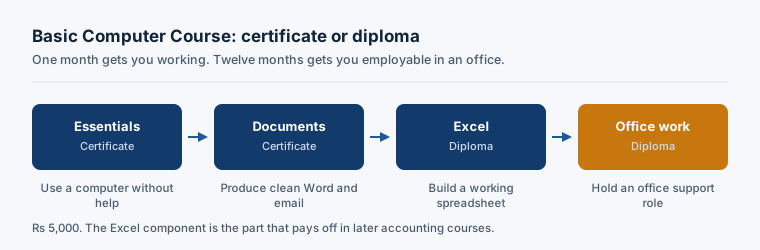
Many of the students enquiring from Shakarpur are handling their own finances for the first time, and that changes how the fee question should be approached. The fee is not published; it is given when you enquire. Ask for it in specific terms for both the short certificate and the year-long diploma, and ask what payment arrangements exist for the longer one before you agree to anything.
The month-long certificate is the lower-risk choice for anyone in this position, particularly if a degree or another course is already running alongside. A year is a long time to fund on a shared-room budget, and a course you cannot finish paying for costs more than one you never started.
If accounting is the plan, this is the prerequisite nobody names
A good share of students in this catchment intend to end up in accounts work, and treat computer training as a delay on the way there. It is closer to the opposite. Tally and accounting classes move at the pace of someone who already navigates a file system and understands a spreadsheet, and students who arrive without that spend weeks catching up on something they could have learned properly in a month.
Once the base is solid, the Tally course is the common next step, and studying accounts without a commerce background covers what is realistic for students who took arts or science at school. Details of the foundation itself are on the course page.
Common questions from Shakarpur
I do not own a laptop. Can I still take the course?
Yes, and a lot of students here are in that position. Ask about machine time when you enquire so you know exactly what practice you are getting.
Can the fee be paid in parts?
Ask, and get a concrete answer rather than a general one. It is the most common question from this area and it deserves specifics before you enrol.
I am doing a degree at the same time. Is that workable?
For the one-month option, usually. For a full year alongside a degree, look hard at your actual free hours first rather than assuming proximity solves it.
Do I need this before Tally, or can I go straight in?
Go straight in only if you can already create, save and find files and work confidently in a spreadsheet. If either of those makes you hesitate, take the foundation first.