Preet Vihar is two stops down the Blue Line from Laxmi Nagar, in a settled residential district of planned colonies and families who have been there a generation. A lot of the people who enquire from here are living at home after a degree, working out what comes next, and the call often arrives with a parent listening in or asking the questions outright. The questions are almost never about the timetable.
The question from Preet Vihar is what it is worth
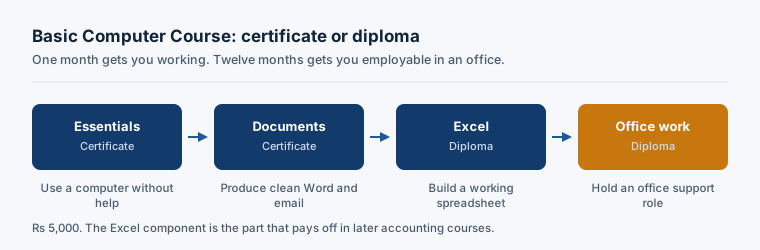
Families here want to know what a computer qualification buys, and that deserves a straight answer rather than reassurance. A foundation course is not a career. It is a floor. It puts you at the point where an employer’s basic expectations are met and the conversation can move on to whatever you are actually being hired for.
That sounds modest and it is, but the floor is where most young graduates from this area are losing ground. A degree certificate and an inability to produce a formatted document are a bad combination in an interview, and it is a combination that is entirely fixable in weeks.
An honest account of what the certificate does and does not do
Employers very rarely hire somebody because they hold a basic computer certificate. They regularly stop considering somebody who cannot demonstrate the skills it represents. That asymmetry is the point. The certificate is not a selling document, it is the removal of a disqualification, and it is most useful when it sits underneath something else on the CV.
What it genuinely does is give a structured month with a teacher present when you get stuck, which is the part self-teaching on a borrowed laptop never provides. Most people can learn Word alone. Very few learn Excel alone, and Excel is the component that matters if anything numerical is in your future.
When the twelve-month diploma earns its year
A year is a serious commitment for a household to agree to, and it should not be made by default. The diploma is the right choice where computing itself is intended to be the skill on offer, and where there is a full year available without a job waiting at the end of the month.
Where a family is really planning a route into accounts, finance or office administration, the calculation changes. In that case a shorter foundation followed by a specialist qualification usually produces a more employable person in the same twelve months than the foundation alone does. Set the two options side by side before choosing, and ask what each costs, since neither figure is published and both are given on enquiry.
For a graduate without commerce subjects, this is the step before the real one
A large share of the young people enquiring from Preet Vihar hold a BA or a general degree and have been told, correctly, that accounting work pays better than what they are being offered. The obstacle they hit is not the accounting. It is that a Tally or accounts class assumes a spreadsheet is already familiar territory.
This course removes that obstacle, and then the decision is which specialisation to take. Comparing the accounting courses is the sensible next reading, and options after 12th without commerce covers the same ground for someone who has not finished a degree at all.
Common questions from Preet Vihar
My son has a degree. Is a basic course a step backwards?
No, it is a step sideways that most degrees skip entirely. A general degree teaches a subject, not a keyboard, and employers assume the keyboard separately.
Will this get a job on its own?
Usually not, and anyone promising otherwise is overselling. It makes the next qualification possible and stops the current applications failing on a technicality.
How much does it cost?
The fee is shared when you enquire, not advertised. Ask on 9212008787 for the certificate and the diploma together, so the family is comparing real numbers.
Should we do this first or go straight into an accounting course?
If the student cannot comfortably build a spreadsheet, do this first. Going straight in usually means paying for an accounting course and spending the first month learning what this one teaches.