Karkardooma is three stops from Laxmi Nagar on the Blue Line, and it has an occupational character that shapes who asks about this course. The courts complex and the district centre around it support a dense population of advocates, tax practitioners and the clerical staff who work for them. Unlike most of the catchment, the people enquiring here are rarely deciding on a career. They are already inside one, in a support role, and the office has moved on without them.
The enquiries come out of offices, not out of career planning
A legal or tax practice runs on documents. Drafts, annexures, letters, filings, and an endless volume of correspondence that has to be produced, corrected, stored and retrieved on demand. The assistant who handles that work is expected to be quick and accurate with it, and increasingly to do it on a screen rather than on paper.
Somebody who has been managing that role capably for years without computer training is in an awkward position. The competence is real, the tooling is missing, and the gap widens every time the office adopts something new. A short, structured foundation closes it without anyone having to pretend it was never there.
Document work pays the rent here, spreadsheet work pays the promotion
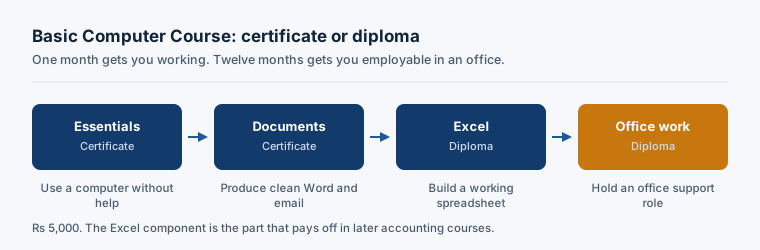
For day-to-day survival in an office of this kind, the order of usefulness is clear. Word first, because formatted documents are the output the office is judged on. Email and file handling next, because correspondence and retrieval are constant. PowerPoint comes last and matters least in this particular setting.
Excel changes the picture, though, and it is worth understanding why before dismissing it as irrelevant to a document-heavy job. The tax practices in this district work in spreadsheets continuously: computations, schedules, reconciliations, client lists. Staff who can work confidently in Excel get handed that work, and it is better paid than typing. That is the single component most likely to change what your employer asks you to do.
A month around a working day, rather than a year away from one
Very few people in full-time clerical employment can give a year to a foundation course, and for most of this group they should not try. The one-month certificate is the proportionate choice: short enough to fit around a working day three stops away, long enough to cover the ground properly, and finished before the office notices.
The twelve-month diploma makes sense in a narrower case, where someone is not currently employed, or is deliberately changing direction rather than improving in place. If you are already in a chambers or a practice, the certificate followed by something specialist is almost always the better use of the same year. The course page covers what the foundation includes.
The tax side of this district hires on a different skill
Karkardooma produces an unusual number of enquiries from people who already work adjacent to taxation, which makes the question of what comes next more concrete than it is elsewhere. For staff in a practice handling returns and compliance, the natural progression is the GST practitioner course, which assumes spreadsheet and portal familiarity rather than teaching it. For offices keeping books as well, the Tally course is the other common route.
Common questions from Karkardooma
My work only needs documents and email. Is the rest wasted?
Not really. The parts you use daily will be strongest, and the spreadsheet section is the one that later decides whether you stay in document work or move beyond it.
I can type, but nothing else. Where does that leave me?
Further ahead than most beginners. Typing speed is the slow part to acquire and you already have it; what is left is structure, formatting and files.
Can I attend around court hours?
Batches run at different times of day and this is the first thing to settle. Ask for current timings when you enquire and match them against your own working pattern before committing.
Is this enough to start the GST course?
For someone already working near tax matters, generally yes. The foundation supplies the spreadsheet and internet skills the GST syllabus takes for granted.